The Market (1959)
the business of living
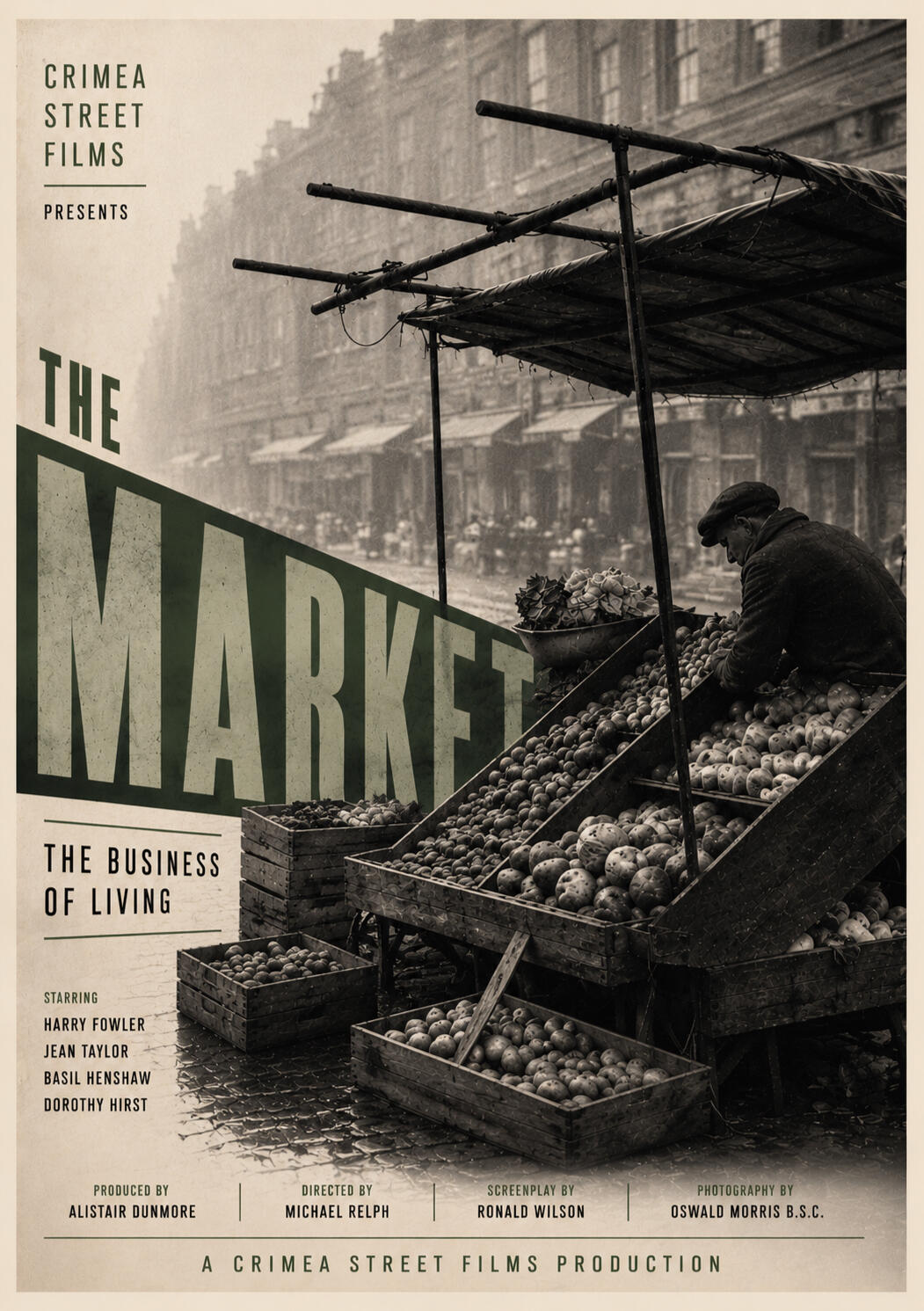
Released in the spring of 1959, The Market was the eighth feature produced by Crimea Street Films.Directed by Peter Halliday and produced by Alistair Dunmore, the film took as its subject the everyday life of a northern street market and the community that depended upon it.Set against a backdrop of rain-soaked cobbles, canvas awnings and crowded stalls, The Market explored the routines and relationships of traders and customers at a time when traditional ways of life were beginning to change.Characteristically for Crimea Street Films, it found quiet drama in ordinary places and the people who worked within them.Neither a critical sensation nor a major box-office success, The Market nevertheless found an appreciative audience and has since become one of the more recognisable productions in the Crimea Street Films catalogue.
The Market follows the fortunes of Arthur Gledhill, a long-established fruit and vegetable trader whose market stall has been at the centre of his working life for decades. As he goes about the familiar routines of buying, selling and keeping one step ahead of the weather, he finds himself surrounded by a community of stallholders, customers and neighbouring shopkeepers whose lives are closely intertwined.Rather than building towards a single dramatic event, the film unfolds through a series of everyday encounters. Small disagreements, unexpected friendships and persistent rumours of change gradually reveal the pressures facing a traditional street market as new ways of shopping begin to emerge.Set over the course of several busy market days, The Market is less concerned with commerce than with the people who depend upon it, exploring how ordinary communities adapt when the world around them begins to change.
Production StillOne of the best-known surviving images from The Market captures Arthur Gledhill making his morning preparations before trading begins.Filmed on location during the spring of 1959, the sequence reflects Alistair Dunmore's preference for authentic settings and ordinary working lives.The rain-soaked cobbles, canvas-covered stalls and busy thoroughfares became some of the film's most recognisable visual elements, contributing to the understated realism for which Crimea Street Films became known.
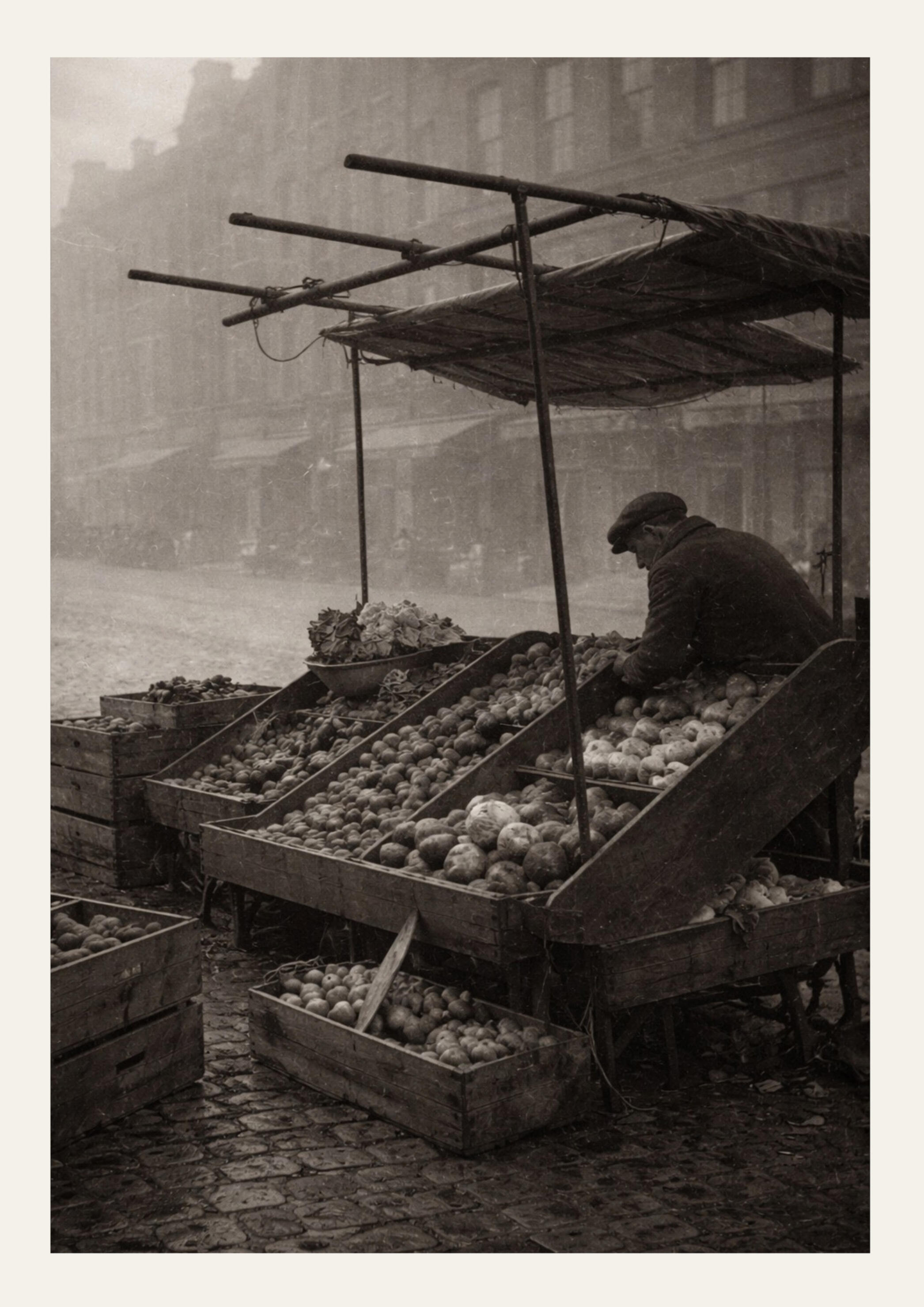
Making The MarketMuch of the film was shot on location in a busy northern street market, with director Peter Halliday favouring genuine trading environments over purpose-built sets.The constant movement of customers, delivery vans and stallholders created practical difficulties but gave the production much of its natural character.Uncooperative weather frequently interrupted filming, although the cast and crew eventually came to accept rain as part of the production. Wet cobbles, dripping canvas awnings and crowded market stalls would later become some of the film's most memorable visual features.Producer Alistair Dunmore was keen to avoid rehearsed performances, encouraging actors to mix with genuine traders and observe the routines of market life before filming began.Several local stallholders reportedly appeared in background scenes, adding to the authenticity that reviewers would later note.
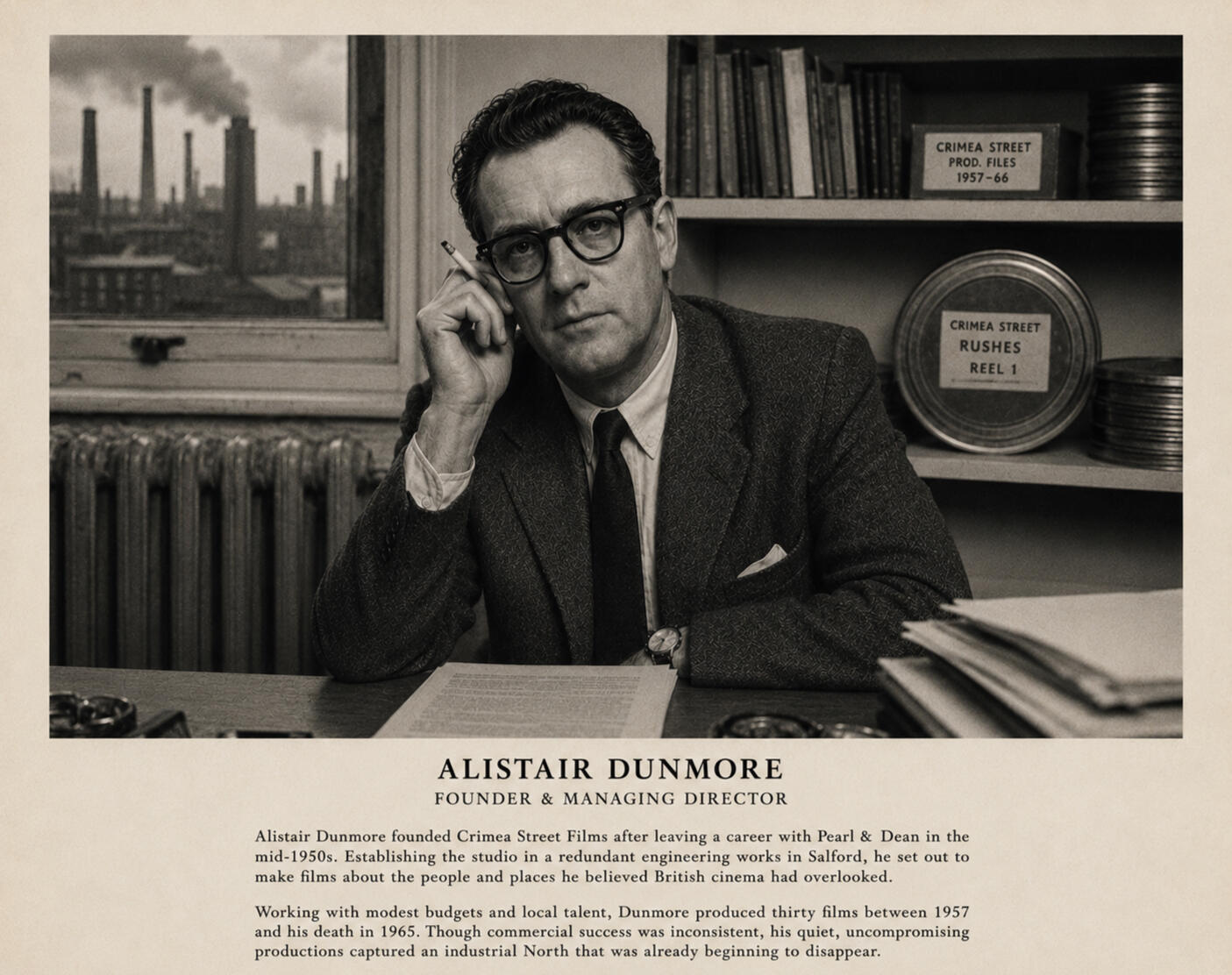
Alistair Dunmore (1919-1965)Alistair Dunmore was born in Cleveleys in 1919, the son of a warehouse clerk and a part-time cinema pianist. He left school at fourteen and worked as an office boy, delivery driver and projectionist's assistant before the Second World War interrupted everything.In reality, he didn’t see any action and found himself down south in barracks near Shepton Mallet where he spent most of his time playing snooker or avoiding swimming lessons.After the war he found himself in a series of dead end jobs until in 1953 he joined new business Pearl & Dean as an advertising salesman for the North West.In 1956, after a modest inheritance and a difficult conversation with his employers, Dunmore made a life-changing decision. He leased a redundant engineering works in Salford and, with a handful of people, established Crimea Street Films.Convinced he had learned his trade with Pearl & Dean, he did at least capitalise on the networks he had built in the region with cinema managers, hungry actors and several competent technicians.His contemporaries rarely described him as easy-going, though most considered him fair. He was stubborn, taciturn and entirely unconcerned with fashion. As anyone who sat through one of his productions could testify, the audience was seldom his first consideration. His dialogue was sparse, his characters reserved and the weather rarely improved.
The high point arrived unexpectedly with ‘The Bridge’ in 1962 when it only lost out to the now Northern 60’s classic ‘A Taste of Honey’. Dunmore accepted the attention almost begrudgingly before returning to make more films.Crimea Street Films released thirty pictures between 1957 and 1966. Some found audiences, some disappeared almost immediately and several were thought lost for many years. Together they formed a portrait of an industrial Britain that was vanishing even as it was being filmed.He died at the age of 46 in 1965 when involved in a car accident in Wythenshawe. The last picture he produced, ‘The Corner’ was posthumously released the following year. The studio continued without him until late 1966 when it finally closed its doors after 9 years and 30 films.Rising costs, changing tastes and the difficulties of independent production finally caught up with the company. The buildings were sold and eventually returned to industrial use.A former colleague wrote that Alistair Dunmore never wanted to make famous films. He wanted to make honest ones. Whether he succeeded is a matter of opinion. That he left behind a small corner of British cinema unlike anything else is rather harder to argue against.
Contemporary ReceptionCritical reaction to The Market was mixed, though many reviewers praised its authentic portrayal of everyday life and the understated performances of the cast. Several newspapers observed that the market itself often seemed to take centre stage, providing a constantly changing backdrop to the lives of its traders and customers.The Manchester Evening Chronicle described the production as:"An affectionate but unsentimental portrait of people whose livelihoods depend upon tomorrow's weather."The Yorkshire Post offered similar praise:"The market itself emerges as the film's principal character, bustling, weary and quietly resilient."Not every critic was convinced. The Daily Sketch famously remarked:"Its dramatic high point appears to be a discussion about the price of cabbages."Even less enthusiastic reviews, however, acknowledged the convincing atmosphere created by the production and the film's eye for the small details of everyday life that larger studios often overlooked.
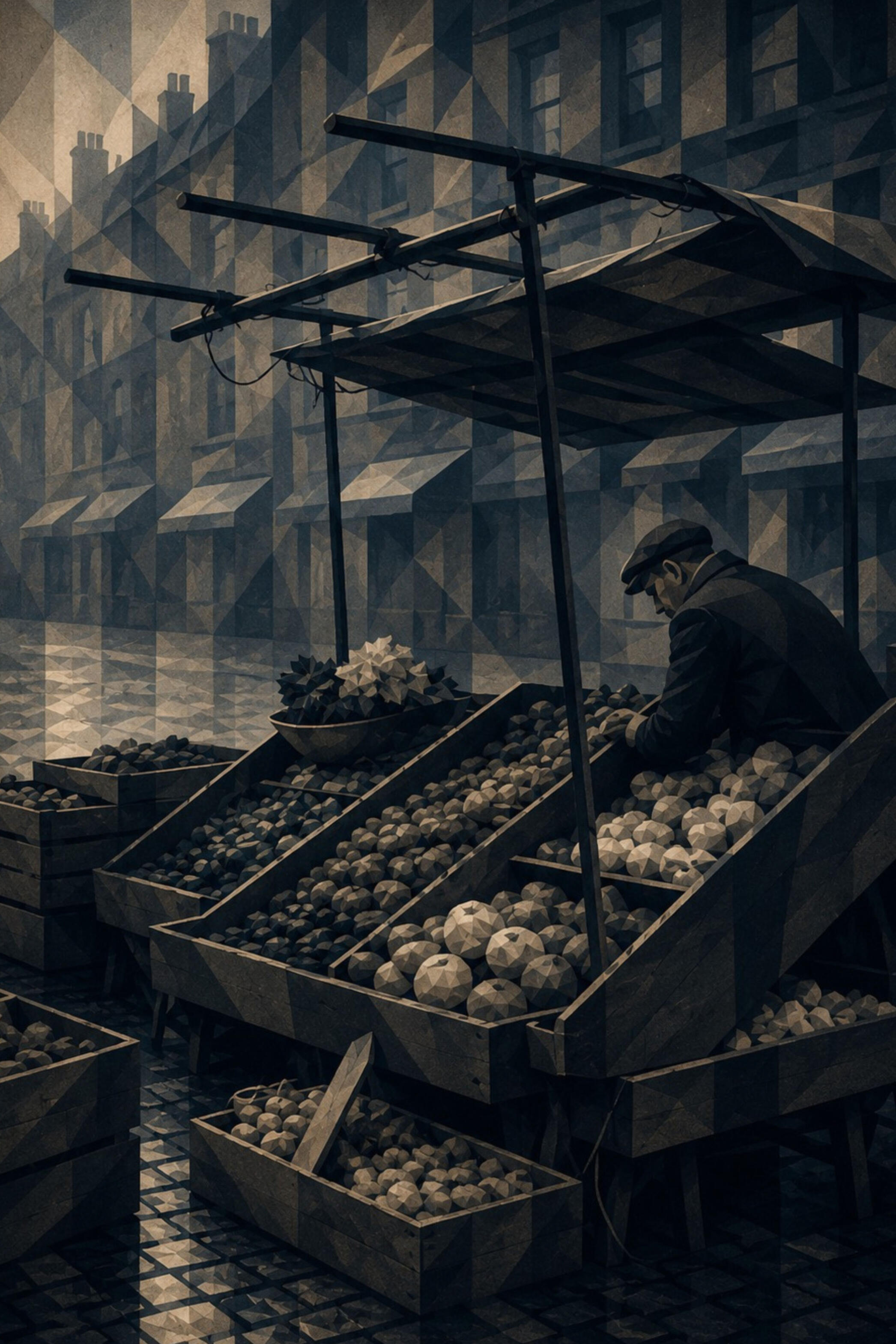
The Market (Northern Deco)The distinctive imagery of The Market has continued to inspire contemporary artists.In this Northern Deco interpretation, Olive James reimagines the familiar market stalls, striped awnings and rain-soaked streets through a bold geometric style while preserving the character and atmosphere of the original film.Drawing upon the everyday scenes that fascinated Crimea Street Films, the work offers a fresh perspective on one of the studio's most recognisable productions and its enduring celebration of ordinary northern life.
From the ArchiveAmong the surviving Crimea Street Films papers is a production memorandum noting that several local stallholders continued trading while scenes were being filmed.Rather than clear the market, the production team worked around the traders, occasionally pausing to allow customers to make their purchases before the cameras rolled again.The note concludes simply: "Business before cinema. They were here first."